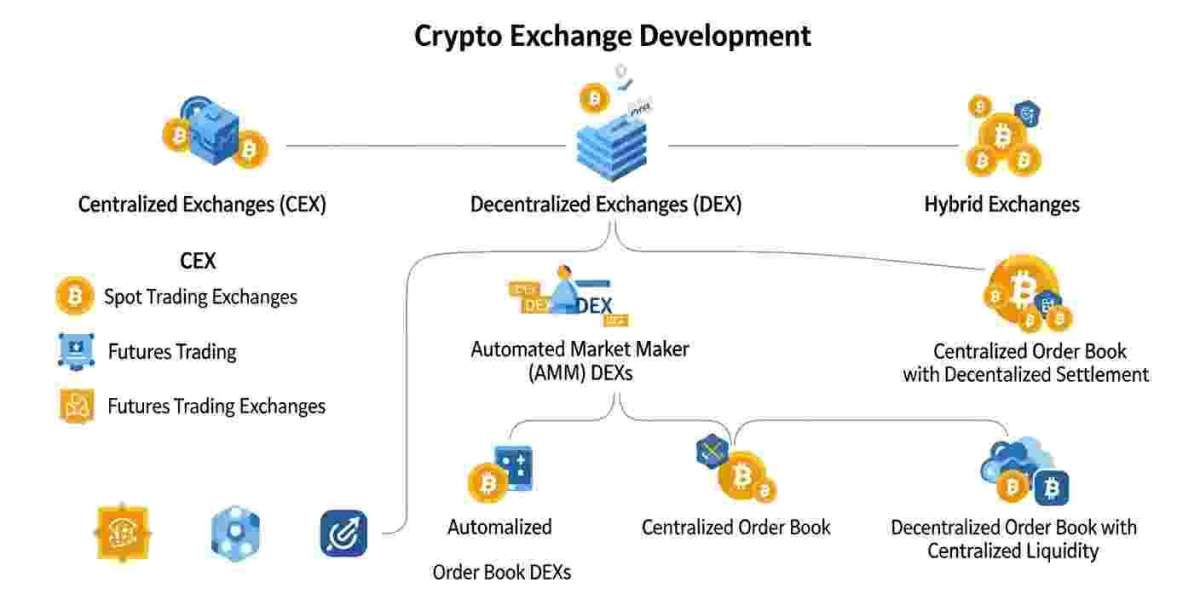
Cryptocurrency exchanges are no longer one-size-fits-all platforms. They are sophisticated ecosystems designed to support a wide range of real-world trading scenarios from casual investing and day trading to institutional hedging and decentralized asset swaps. Each scenario requires specific tools, execution models, and risk controls.
To meet these demands, Crypto exchange development strategically maps different exchange types centralized, decentralized, hybrid, and derivatives to real-world trading behaviors. This mapping ensures that users can operate in environments that match their goals, risk tolerance, and technical preferences.
At the heart of this capability is Cryptocurrency exchange software development, which enables platforms to dynamically align features, liquidity models, and execution systems with actual user needs. A professional Cryptocurrency exchange development company leverages advanced Crypto exchange development services to build platforms that replicate real-world financial use cases in a digital environment.
Key highlights of mapping exchange types
• Aligns trading environments with real-world user needs
• Supports diverse trading strategies and scenarios
• Enhances efficiency and usability across user segments
• Enables realistic financial operations in crypto markets
• Improves liquidity distribution across platform modules
• Strengthens user engagement and retention
• Drives platform scalability and adaptability
How Centralized Exchanges Support High-Frequency and Retail Trading
Centralized exchanges (CEX) are designed to replicate the experience of traditional financial markets, making them ideal for high-frequency traders and retail users. These platforms are optimized for speed, liquidity, and ease of use, allowing users to execute trades instantly.
In real-world scenarios, retail investors often seek simplicity and quick access to markets. Crypto exchange development addresses this by integrating user-friendly interfaces, instant order execution, and deep liquidity pools. Cryptocurrency exchange software development ensures that these systems operate with minimal latency, enabling fast decision-making.
High-frequency traders, on the other hand, require advanced tools such as algorithmic trading, low-latency APIs, and real-time analytics. CEX platforms provide these capabilities, allowing traders to capitalize on small price movements.
Additionally, centralized exchanges offer custodial services, making them suitable for users who prefer convenience over self-management of assets. This mirrors traditional brokerage systems where users rely on intermediaries for execution and security.
Key real-world applications of CEX
• Retail investing with simple buy/sell operations
• High-frequency trading with low latency execution
• Day trading based on real-time market data
• Institutional trading with large liquidity access
• Fiat-to-crypto conversions for new users
• Portfolio management within a single platform
• Access to advanced trading tools and analytics
A Cryptocurrency exchange development company ensures that CEX platforms effectively support these real-world scenarios.
How Decentralized Exchanges Enable Peer-to-Peer Asset Control
Decentralized exchanges (DEX) are built for users who prioritize autonomy, transparency, and direct asset control. These platforms eliminate intermediaries, allowing users to trade directly from their wallets.
In real-world scenarios, DEX platforms are ideal for users who want full ownership of their funds and prefer trustless systems. Crypto exchange development integrates smart contracts to automate trade execution without relying on centralized authorities. Cryptocurrency exchange software development ensures that these contracts are secure and efficient.
DEX platforms are also widely used for accessing newly launched tokens and participating in decentralized finance (DeFi) ecosystems. This makes them suitable for early adopters and tech-savvy users.
While DEX platforms may have limitations in terms of speed and liquidity, continuous innovation is improving their performance and usability.
Key real-world applications of DEX
• Peer-to-peer trading without intermediaries
• Self-custody of digital assets
• Participation in DeFi ecosystems
• Access to newly launched tokens
• Transparent and verifiable transactions
• Cross-wallet trading operations
• Privacy-focused trading activities
A Cryptocurrency exchange development company ensures that DEX platforms align with decentralized trading needs.
How Hybrid Exchanges Bridge Institutional and Retail Needs
Hybrid exchanges combine the strengths of centralized and decentralized models, making them suitable for a wide range of real-world scenarios. They offer the speed and liquidity of CEX platforms while maintaining the security and control of DEX systems.
In Crypto exchange platform development, hybrid models integrate centralized matching engines with decentralized custody solutions. Cryptocurrency exchange software development ensures seamless interaction between these components.
This approach is particularly useful for institutional traders who require high performance but also demand enhanced security and transparency. It also appeals to retail users who want a balanced trading experience.
Hybrid exchanges enable flexible trading environments, allowing users to switch between custodial and non-custodial modes as needed.
Key real-world applications of hybrid exchanges
• Institutional trading with enhanced security
• Retail trading with flexible custody options
• Cross-platform asset management
• High-speed execution with decentralized control
• Secure handling of large-volume trades
• Integration with multiple liquidity sources
• Balanced risk and performance management
A Cryptocurrency exchange development company ensures that hybrid platforms deliver versatility and efficiency.
How Derivatives Platforms Support Hedging and Speculation
Derivatives exchanges are designed for advanced trading scenarios such as hedging, leverage trading, and speculation. These platforms replicate traditional financial instruments like futures and options in the crypto space.
In real-world trading, derivatives are used by institutions and experienced traders to manage risk and maximize returns. Crypto exchange development includes specialized systems for handling these complex instruments. Cryptocurrency exchange software development ensures accurate pricing, margin management, and risk control.
Derivatives platforms allow users to take positions on price movements without owning the underlying asset. This is particularly useful for hedging against market volatility or speculating on future trends.
These platforms require robust infrastructure to handle high volumes and ensure stability.
Key real-world applications of derivatives exchanges
• Hedging against market volatility
• Leveraged trading for higher returns
• Speculation on price movements
• Risk management for institutional portfolios
• Arbitrage opportunities across markets
• Advanced trading strategies and algorithms
• Continuous market exposure without asset ownership
A Cryptocurrency exchange development company ensures that derivatives platforms meet the needs of professional traders.
How Liquidity Models Align With Trading Scenarios
Liquidity is a critical factor in mapping exchange types to real-world scenarios. Different trading environments require different liquidity models to function effectively.
Crypto exchange development integrates various liquidity mechanisms such as order books, automated market makers (AMMs), and aggregated liquidity pools. Cryptocurrency exchange software development ensures that these systems operate seamlessly.
For example, order book models are ideal for high-frequency trading, while AMMs are better suited for decentralized environments. Aggregated liquidity pools support cross-market trading and large-volume transactions.
By aligning liquidity models with trading scenarios, exchanges can provide optimal execution and pricing.
Key liquidity alignment features
• Order book systems for active trading
• AMM models for decentralized environments
• Aggregated liquidity for cross-market access
• Dynamic adjustment based on market conditions
• Support for large and complex trades
• Improved price discovery and stability
• Enhanced trading efficiency
A Cryptocurrency exchange development company ensures that liquidity systems match user needs.
How Personalization Maps User Behavior to Exchange Types
Personalization plays a key role in aligning exchange types with real-world scenarios. By analyzing user behavior, exchanges can recommend or automatically adjust trading environments.
Crypto exchange development includes data analytics and AI-driven systems that track user activity. Cryptocurrency exchange software development ensures that these insights are used to customize the platform.
For example, beginner users may be directed to simplified interfaces, while advanced traders are provided with complex tools and features. This ensures that each user operates in an environment suited to their needs.
Personalization also improves user engagement and retention by providing relevant features and recommendations.
Key personalization features
• Behavioral analysis for user segmentation
• Customizable trading interfaces
• Adaptive feature recommendations
• Tailored notifications and alerts
• Simplified onboarding for beginners
• Advanced tools for experienced traders
• Continuous improvement based on user data
A Cryptocurrency exchange development company ensures that personalization enhances usability and efficiency.
Conclusion
Mapping exchange types to real-world trading scenarios is essential for creating versatile and user-centric cryptocurrency platforms. By aligning platform features with actual user needs, exchanges can deliver more effective and engaging trading experiences.
At the core of this approach is Cryptocurrency exchange software development, which enables dynamic adaptation, real-time analysis, and seamless integration of multiple trading models. A reliable Cryptocurrency exchange development company uses advanced strategies to build platforms that reflect real-world financial operations.
Through comprehensive Crypto exchange development services, exchanges can support a wide range of scenarios—from retail investing and peer-to-peer trading to institutional hedging and advanced speculation.
Key takeaways
• Different exchange types serve different real-world trading needs
• Centralized platforms support speed and liquidity
• Decentralized platforms provide control and transparency
• Hybrid models offer flexibility and balance
• Derivatives platforms enable advanced trading strategies
• Liquidity models must align with trading scenarios
• Personalization enhances user experience and engagement
As the cryptocurrency ecosystem continues to evolve, the ability to map exchange types to real-world scenarios will remain a key factor in building scalable and successful trading platforms.